

AI Found the Bug. Who Will Fix It on Your Server?
Between 21 October and 18 November 2026, three of the most widely used building blocks of the web (PHP, Node.js and NGINX) each issued urgent security alerts. Each one could let an outsider run their own code on a business’s server without ever logging in.
One of these flaws was found by an AI security maintenance tool. One had been sitting quietly inside NGINX since 2015. And for many businesses, all three landed on platforms that had been “running fine for years” with nobody actively looking after them.
If your revenue, operations or customers depend on a software platform, this article is for you. It explains why these alerts matter to decision makers, not just developers, and why replacing your engineering support with AI is not yet a safe bet.
Four Weeks, Three Major Alerts
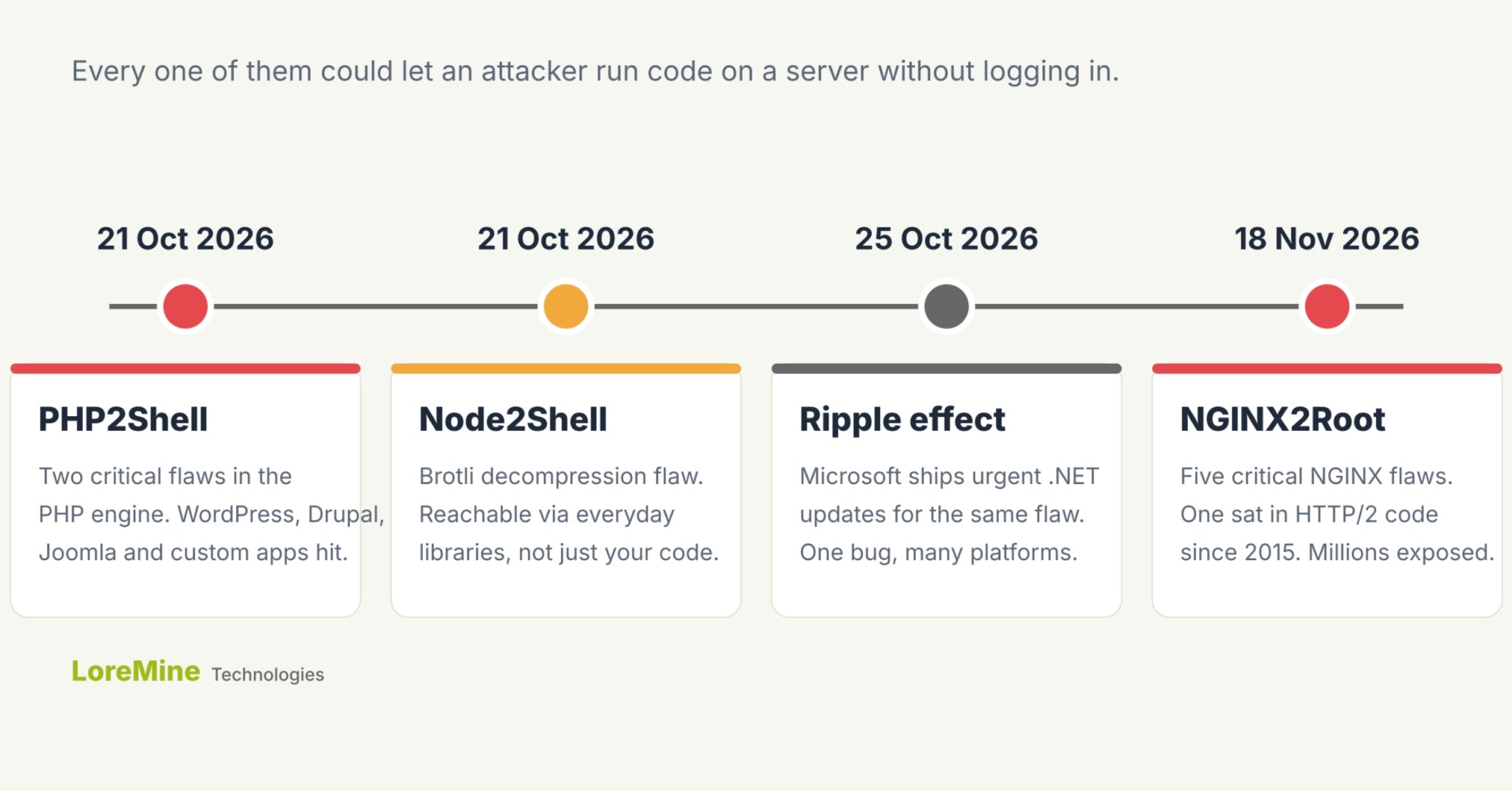
PHP2Shell: the engine under millions of websites
On 21 October, the PHP project shipped an emergency release for two critical flaws in the PHP engine itself, collectively named PHP2Shell. An attacker can send a series of crafted web requests and end up running code on the server. Because the flaw is in PHP itself, it doesn’t matter how well your own application is written. Researchers demonstrated attacks against WordPress, Drupal and Joomla, and security teams advised treating it as actively exploited.
Node2Shell: a flaw you never wrote
The same day, Node.js fixed a high-severity flaw in its built-in Brotli decompression code, later nicknamed Node2Shell. The uncomfortable detail: an application can be exposed even if its developers never wrote a single line of decompression code, because everyday libraries and web requests can reach it automatically. Researchers demonstrated code execution on an official Node.js build. Microsoft then had to ship urgent .NET updates for the same underlying flaw, showing how one bug can travel across platforms.
NGINX2Root: the front door of the internet
On 18 November, F5 released fixes for five critical NGINX flaws, grouped under the name NGINX2Root. NGINX sits in front of a huge share of the world’s websites and APIs. Researchers showed code execution on a server doing nothing more than serving ordinary static files over HTTPS: no application bugs needed. Censys estimated around 8.8 million NGINX services were potentially exposed to just one of these flaws.
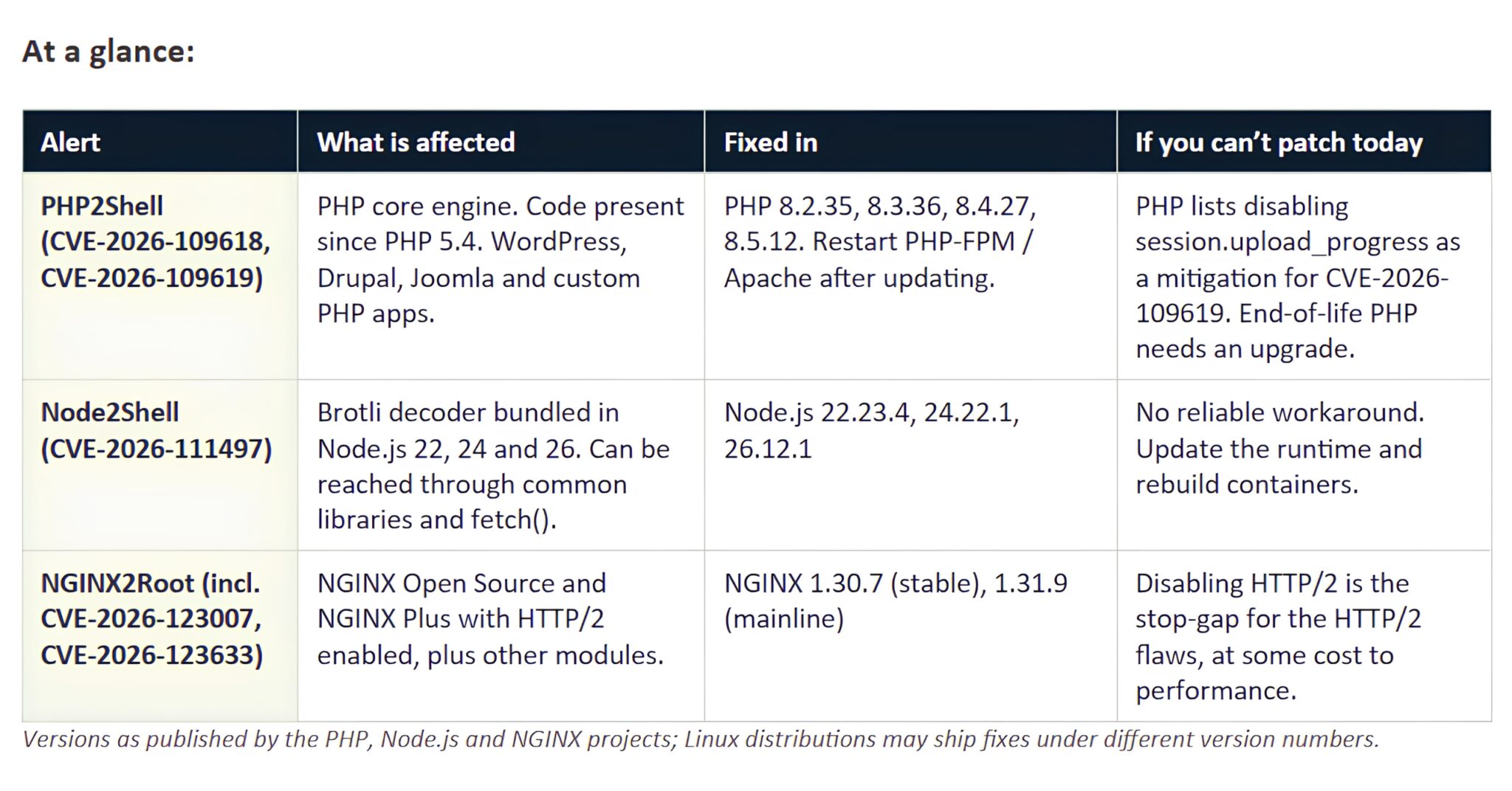
“It’s been running fine for years” is not a security strategy
Many businesses run their core platform (an ERP, a customer portal, an e-commerce site, a booking engine) on software built years ago by a vendor or freelancer who has since moved on. It works. Nobody touches it. The thinking goes: it’s proven, it’s stable, why spend money on it?
These alerts turn that logic upside down.
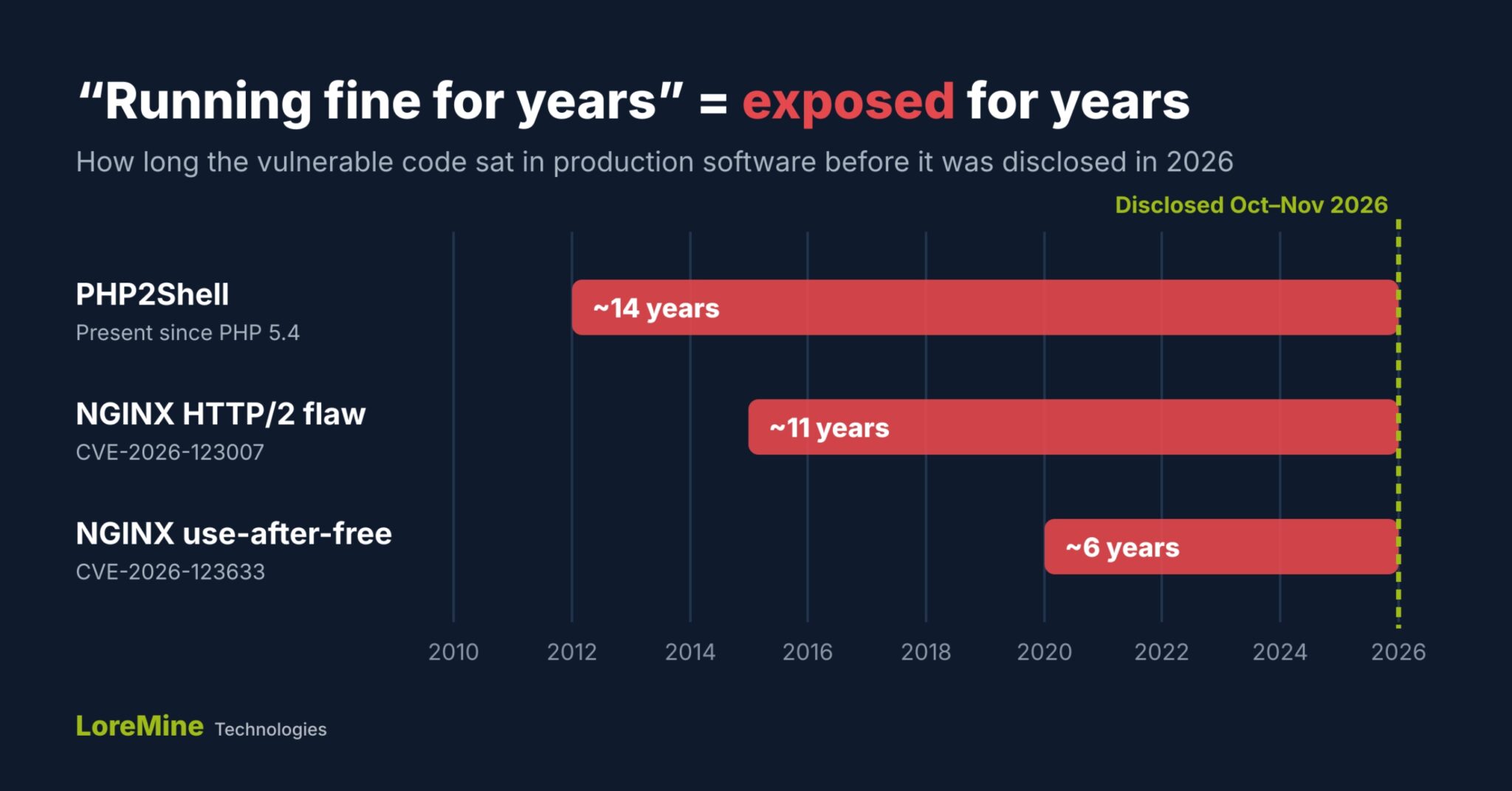
The vulnerable PHP code dates back to PHP 5.4, released in 2012. One of the NGINX flaws has been in the HTTP/2 code since 2015, another since 2020. If your platform has been “running without issues” on these technologies for a decade, it has also been carrying these weaknesses for a decade. Nobody knew, including the attackers, until now. Now everyone knows.
Here is what “running fine for years” often hides:
End-of-life versions
Platforms running PHP 7.x or older Node.js releases generally don’t receive official security fixes anymore. For them, the fix isn’t a patch: it’s an upgrade project, and that takes people who understand the code.
Nobody holds the keys
Server passwords sit with a developer who left, or a hosting account nobody can log into.
Nobody understands the code
When a fix breaks something, there is no one to diagnose it.
Nobody is watching
Security advisories go out to the world. If no one on your side reads them, you find out when your customers do.
AI found the bug. Here’s why it can’t yet fix your server
There is a lot of talk about AI replacing software teams. And AI is genuinely impressive here: the Node.js Brotli flaw was credited to an AI security maintenance tool, OpenAI’s Codex Security. AI tools can read an advisory, explain it in plain language, scan code and suggest a patch in seconds. We use them every day.
But finding a bug in open-source code is a very different job from safely fixing it on your production systems. Here is why AI alone cannot yet monitor, assess and fix a running business platform:
AI doesn’t know what you’re running.
It can’t see the forgotten subdomain, the old Docker image pinned years ago, or the second server the original developer set up. Someone has to know, and keep track of, your real environment.
Exposure depends on your exact setup.
The NGINX flaws matter only if HTTP/2 is enabled. PHP2Shell depends on server and session settings. Node2Shell can be reached through ordinary middleware. Answering “are we affected?” means inspecting the live system, not reading a summary.
Sometimes there is no patch.
A related PHP issue was disclosed with a mitigation but no fix. Turning off HTTP/2 or a PHP feature to stay safe is a business trade-off between risk and performance. A person has to make that call and own it.
Applying a fix is operational work.
Updates must be scheduled, workers restarted, containers rebuilt, the application tested and a rollback ready if something breaks. Linux distributions often backport fixes without changing version numbers, so even checking “am I patched?” requires judgement.
Someone must hold the keys and the responsibility.
Giving an autonomous AI agent unrestricted root access to production systems is itself a serious security risk. Accountability for downtime, data and compliance still sits with people.
AI is speeding up attackers too.
The same tools that find bugs faster also help attackers build exploits faster. More disclosures and shorter warning times mean more work for your engineers, not less.
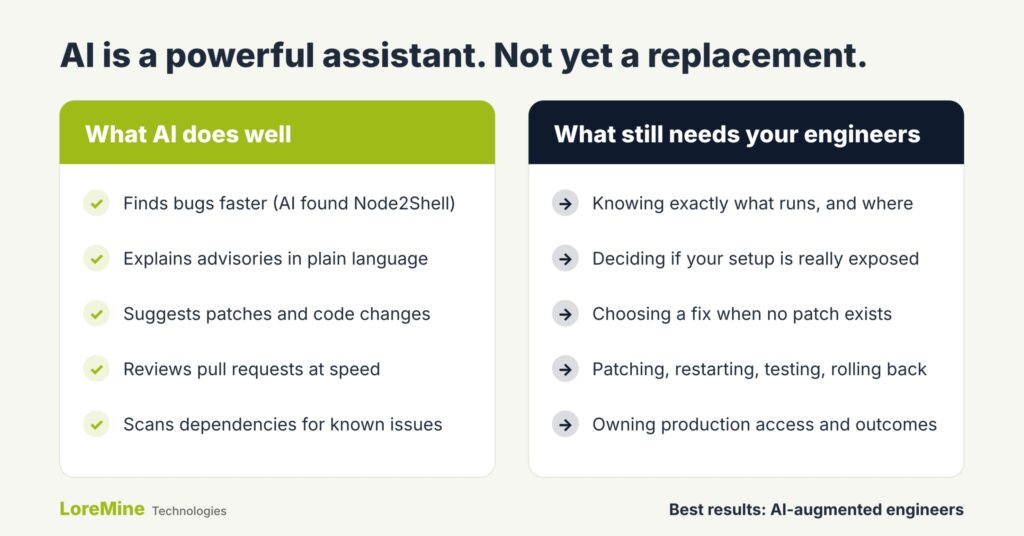
The honest position for 2026: AI makes good engineers faster. It does not yet make engineers unnecessary. The businesses that will cope best are those with AI-augmented engineers, not those that removed the engineers and kept the AI.
What this looked like for our clients
When PHP2Shell and NGINX2Root were disclosed, the LoreMine team patched PHP and NGINX across all of our clients’ platforms. For each one, that meant:
- Identifying exactly which servers and applications ran the affected PHP and NGINX versions.
- Confirming whether the vulnerable configurations (such as HTTP/2) were actually in use.
- Applying the official updates or interim mitigations, and restarting services so the fix actually took effect.
- Testing the applications to make sure nothing broke, before closing the incident.
None of our clients had to read an advisory, decode a CVE number or wonder whether they were exposed. That is what having a support team means. The businesses without one were still trying to find out who had the server password.
Why every software-dependent business needs at least a small support team
You don’t need a large in-house department. But if your business stops when your platform stops, you need a minimum level of cover, the way you insure a building you can’t afford to lose. At a minimum, someone must:
- Know your system: its technologies, versions, servers and integrations.
- Hold access: to servers, hosting, code repositories and backups.
- Watch for advisories affecting your stack, and assess them quickly.
- Act fast: patch, mitigate, test and roll back when an alert lands.
- Keep the platform current, so you’re never stuck on an unsupported version when it matters most.
Compare the cost of a small support arrangement with the cost of one day of downtime, a data breach, or a ransomware demand. For most businesses, the maths is not close.
How LoreMine can help
LoreMine Technologies has supported business platforms for clients across India, the Gulf, the UK and the US. Depending on what your platform needs, we can help with:
- Security and health review: a structured look at your platform’s technologies, versions, configurations and exposure, with a prioritised action list.
- Emergency patch response: when alerts like PHP2Shell, Node2Shell or NGINX2Root land, we assess your exposure and apply fixes or mitigations safely.
- Ongoing maintenance and support: advisory monitoring, regular updates, testing and controlled deployments, so you’re never caught off guard.
- Legacy modernisation: upgrading ageing PHP, Node.js, .NET and other platforms to supported versions without disrupting your business.
- Dedicated support teams: a small, dedicated engineering team that knows your platform as well as your own staff would.
We work across PHP, Node.js, Python, .NET, ColdFusion, Angular, React, Vue and cloud platforms such as AWS and Azure, including older systems many firms won’t take on. Our engineers use AI-assisted code review alongside in-house QA, DevOps and penetration testing: AI for speed, engineers for judgement.
What to do this week
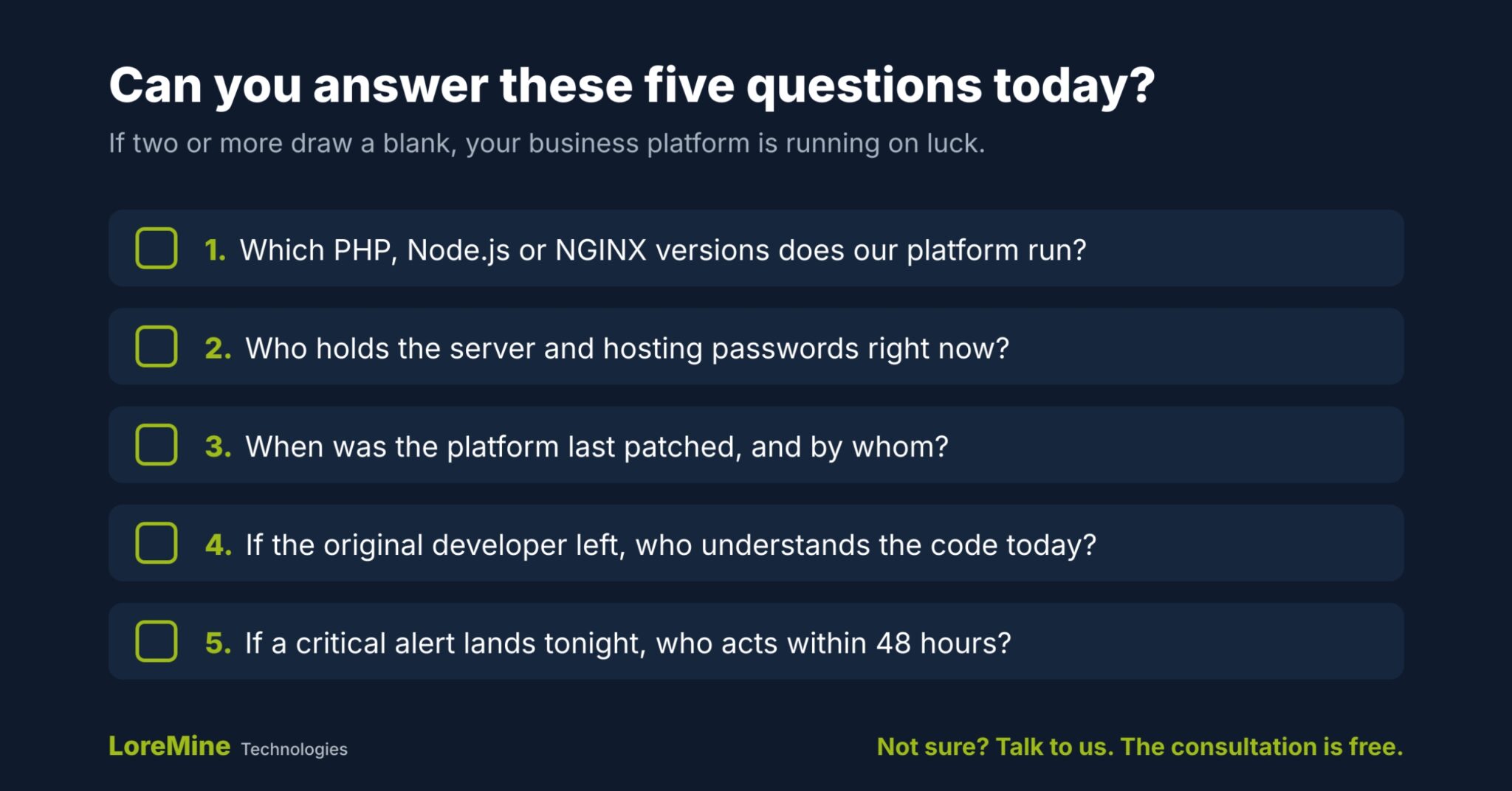
- Ask your team or vendor which PHP, Node.js and NGINX versions your platform runs.
- Confirm they have been updated to the fixed versions listed above, and that services were restarted.
- Check that someone, by name, has current access to your servers and hosting.
- If the answer to any of these is “I’m not sure”, get help now, before the next alert.