

Stop Chasing Invoices: How a Self-Service Client & Vendor Portal Cuts Finance Admin Costs by Over 75%
Industry benchmarks from Ardent Partners and the Institute of Finance & Management (IOFM) show that manual, email-driven invoice and statement handling costs businesses $12–$15 per document and consumes up to 35% of a finance team’s week. By deploying an ERP-integrated Client & Vendor Portal, organizations reduce per-document processing costs by up to 80%, cut approval cycles from 12 days to under 3 days, and immediately reclaim hundreds of operational hours every month.
Discover how integrating a unified self-service portal with your existing SAP or ERP system eliminates manual document bottlenecks, accelerates month-end reconciliation, and frees your finance team for high-value strategic work.
The Hidden Cost of Manual Document Requests
For growing enterprises managing hundreds or thousands of clients and suppliers, sharing routine financial records—such as account statements, tax invoices, payment advices, and statutory TDS/TCS certificates—often remains stubbornly manual. Every week, finance teams field dozens of repetitive emails and phone calls asking: “Can you resend last month’s statement?” or “What is the payment status of Invoice #4082?”
While each individual request may only take 10 to 15 minutes to locate in the ERP, export to PDF, verify, and email, the cumulative drag is severe. According to IOFM and Ardent Partners benchmarks:
-
30% to 40% of Finance Bandwidth Lost: Mid-sized accounts payable and receivable teams spend nearly a third of their workweek responding to routine status inquiries and resending documents.
-
$12 to $15 Cost Per Manual Invoice: When factoring in staff time, email follow-ups, data re-entry, and error resolution, manual document processing costs roughly 5x more than automated self-service.
-
15% to 22% Exception & Dispute Rate: Manual email threads frequently result in outdated ledger versions, mismatched purchase orders, and delayed month-end reconciliations.
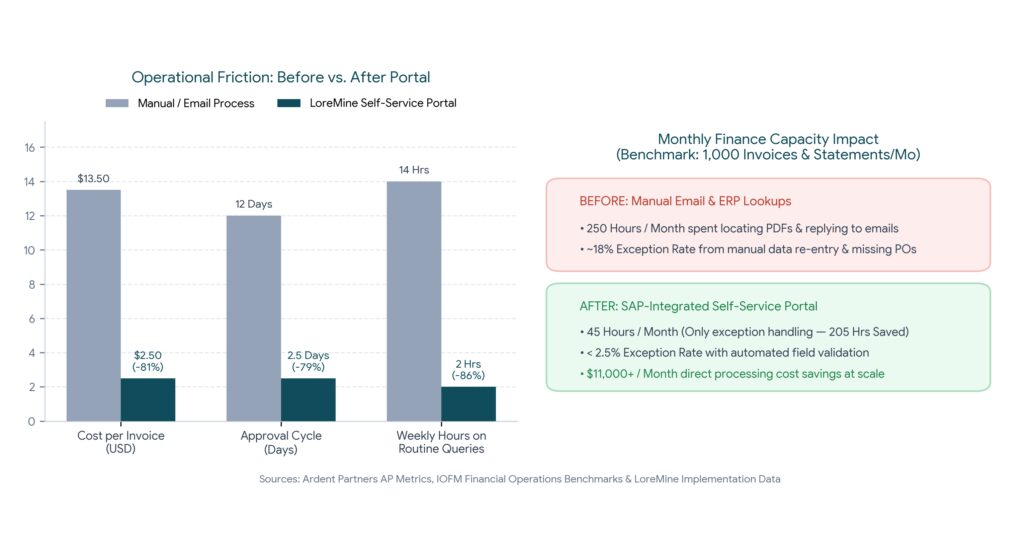
Industry Benchmarks: Savings & Efficiency Gains at a Glance
Replacing ad-hoc email distribution with a centralized Self Service Vendor Portal delivers measurable improvements across cost, speed, and accuracy. The table below outlines standard industry performance shifts observed when organizations transition to automated self-service:
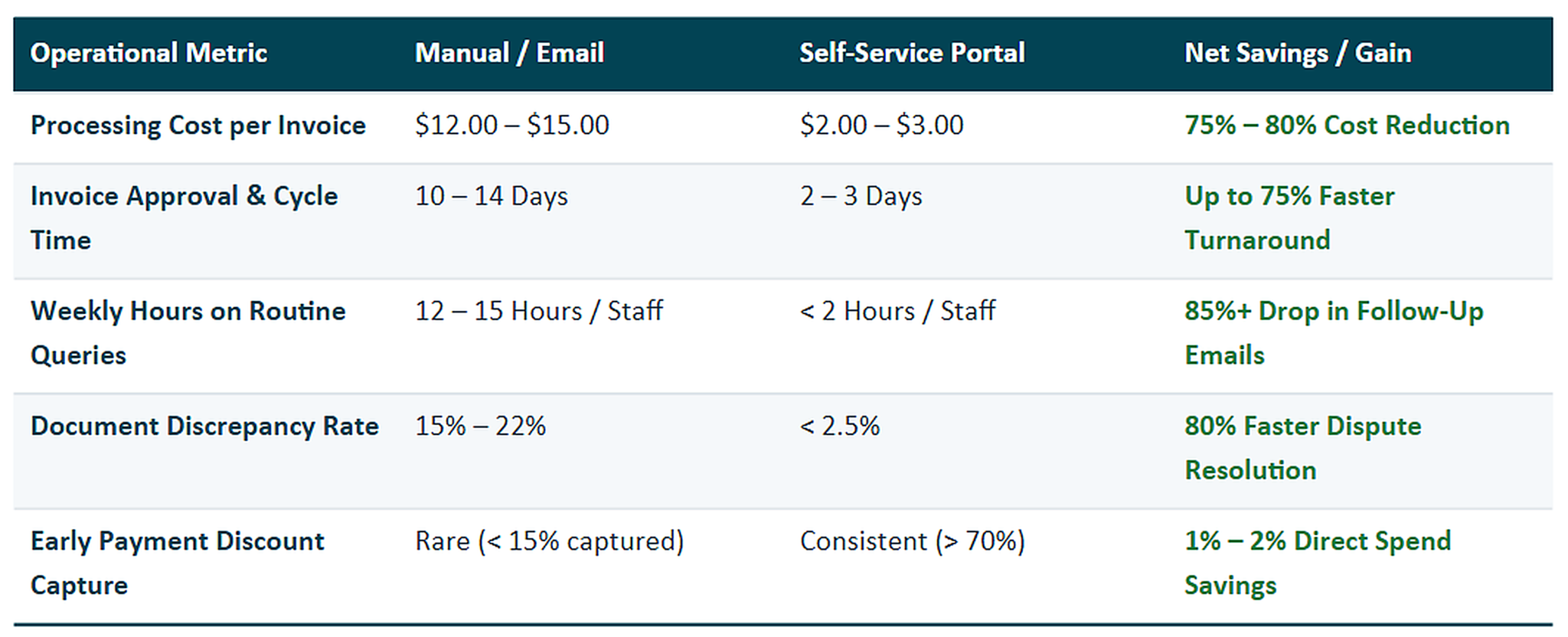
How Seamless ERP & SAP Integration Powers Self-Service
A common misconception among finance leaders is that offering external self-service requires replacing their core accounting software or exposing their internal ERP directly to the internet. Modern API-driven architecture solves both concerns cleanly.
For organizations running SAP or similar enterprise ERPs, lightweight middleware APIs securely extract approved financial records—such as open invoices, account ledgers, payment statuses, and statutory tax certificates—and sync them to a dedicated cloud database. Authorized clients and vendors log into a branded web portal with strict role-based permissions, viewing only their own records in real time while your core ERP remains completely protected.
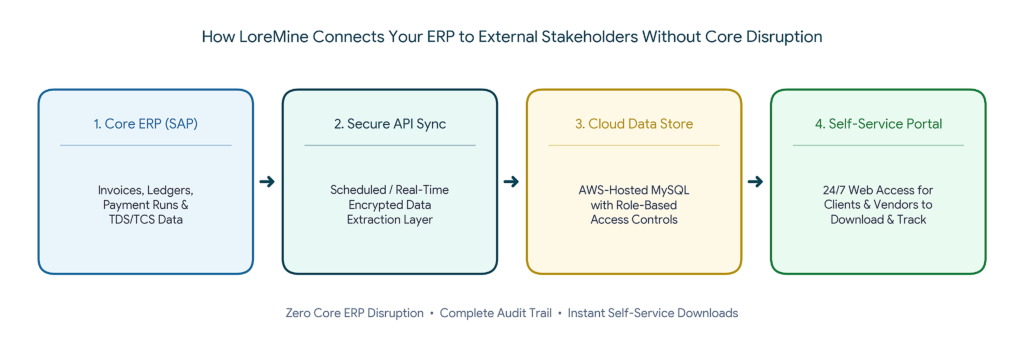
Four Immediate Ways a Portal Transforms Financial Operations
1. Eliminate Repetitive Document Distribution: Clients and vendors download invoices, credit notes, account statements, and TDS/TCS certificates on demand—24/7—without waiting for accounts staff.
2. Accelerate Cash Flow & Receivables: When clients have instant visibility into due dates, itemized statements, and payment links, invoice disputes drop and Days Sales Outstanding (DSO) shrinks measurably.
3. Strengthen Vendor Trust & Transparency: Suppliers can track invoice approval stages and scheduled payment dates independently, eliminating anxious follow-up calls to your procurement and AP desks.
4. Audit-Ready Compliance Trails: Every document upload, ledger sync, and stakeholder download is automatically timestamped and logged, simplifying statutory and internal audits.
Case Study: How LoreMine Reduced Finance Workload at Scale
Real-World Implementation: SAP-to-AWS Self-Service Portal for Thousands of Stakeholders
Challenge: A large enterprise managing thousands of active clients and vendors faced severe bottlenecks in its accounts department. Finance staff were spending hours every day manually exporting and emailing account statements, invoices, and TDS/TCS certificates.
Solution: LoreMine Technologies engineered a custom, secure API integration connecting the client’s existing SAP ERP directly to an AWS-hosted MySQL database powering a dedicated Client & Vendor Portal. Role-based authentication ensured each external stakeholder could generate reports and download verified tax and billing documents independently.
Measurable Result: The finance department immediately achieved over a 10% reduction in overall departmental workload—reclaiming hundreds of staff hours per month—while dramatically improving turnaround times and stakeholder satisfaction, all without modifying their core SAP infrastructure.
Build a Custom Portal Around Your Existing ERP
Every enterprise has distinct workflows, approval hierarchies, and compliance requirements. Whether you operate on SAP, Oracle, Microsoft Dynamics, or a custom accounting platform, LoreMine Technologies designs and builds tailored Client and Vendor Portals that integrate seamlessly with your existing environment.